Object Record
Images
.jpg)
.jpg)
.jpg)
.jpg)
.jpg)
Metadata
Object Name |
Sculpture |
Collection |
Raymond Kaskey Collection |
Catalog Number |
2015.15.4.12 |
Description |
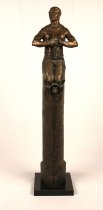
Maquette of Transportation from Sculptures on the Square: This suite of four large bronze sculptures monumentalizes the forces that have shaped the development of Charlotte. The Future, Commerce, Transportation, and Industry are figurative representations that link the city's past, present, and future. Each sculpture is placed at a corner of the intersection of Independence Square, with The Future as the symbolic focus. Transportation is represented by an African American male, portrayed with strength and dignity resting on his knees and with a hammer in his hands, a reference to the men who built Charlotte's rail lines, beginning the city's importance as a transportation hub. The number "1401" inscribed on the figure represents engine "1401", also known as Charlotte, who pulled trains through the city. Each figure, weighing approximately 5,000 pounds, is mounted on a tall, thin granite column approximately 20 feet tall. The columns are modern and angular, with each bronze figure rising from the top, as if growing out of the granite. A plaque commemorating the sculptures as a gift to the people of Charlotte is located in the brickwork of the sidewalk behind the figure of The Future. The sculptures sit in the four corners of Independence Square, a location with significant historic and symbolic meaning in the development of the city. The intersection of Trade and Tryon Streets, considered to be the historical crossing of Indian trade paths, later became the City Center and the basis for the division of Charlotte into blocks and neighborhood wards. The intersection received the name "Independence Square" from the so-called Mecklenburg Declaration of Independence reportedly signed at Charlotte on May 20, 1775. |
Context |
This suite of four large bronze sculptures monumentalizes the forces that have shaped the development of Charlotte, NC. The Future, Commerce, Transportation, and Industry are figurative representations that link the city's past, present, and future. Each sculpture is placed at a corner of the intersection of Independence Square, with The Future as the symbolic focus. The Future is represented as a young child, nurtured and playful in the arms of her mother who emerges organically from the branches of a dogwood tree. The figure also contains a hornets nest as a reference to Charlotte's historical nickname as a "Hornets Nest" of rebellion. Commerce is represented as a realistic rendering of a gold prospector of the late 18th century, marking the gold rush in North Carolina and Charlotte's importance in the founding of the U.S. Mint in the city in 1835. The prospector empties his pan onto a head at his feet, allegedly the image of Alan Greenspan, former Chairman of the Federal Reserve, and demonstrating Charlotte's transition to a major banking and financial center. Transportation is represented by an African American male, portrayed with strength and dignity resting on his knees and with a hammer in his hands, a reference to the men who built Charlotte's rail lines, beginning the city's importance as a transportation hub. The number "1401" inscribed on the figure represents engine "1401", also known as Charlotte, who pulled trains through the city. Industry is depicted as a female millworker with a child at her feet, an allusion to Charlotte's history as a mill town and the role of child labor in the era before federal labor laws protecting children from factory work. Each figure, weighing approximately 5,000 pounds, is mounted on a tall, thin granite column approximately 20 feet tall. The columns are modern and angular, with each bronze figure rising from the top, as if growing out of the granite. A plaque commemorating the sculptures as a gift to the people of Charlotte is located in the brickwork of the sidewalk behind the figure of The Future. A plaque commemorating the sculptures as a gift to the people of Charlotte is located in the brickwork of the sidewalk behind the figure of The Future. The sculptures sit in the four corners of Independence Square, a location with significant historic and symbolic meaning in the development of the city. The intersection of Trade and Tryon Streets, considered to be the historical crossing of Indian trade paths, later became the City Center and the basis for the division of Charlotte into blocks and neighborhood wards. The intersection received the name "Independence Square" from the so-called Mecklenburg Declaration of Independence reportedly signed at Charlotte on May 20, 1775. |
Currently On Display In |
Visible Vault: Open Collections Storage |
Date |
c. 1995 |
Maker |
Raymond Kaskey |
Role Artist |
Sculptor |
Made In |
Laran Bronze |
Donor |
Raymond Kaskey |
Dimensions |
H-38 W-9.5 D-8 inches |
Lexicon Category |
8: Communication Artifact |
Search Terms |
african american male hammer railroad transportation |